Ever since the 1960’s people launched things into space. Maybe it was satellites, people, space stations, whatever. Stuff was launched into space. But did you ever stop to think how much of this stuff was actually launched? How many rocket launches have taken place to date, and how did the cadence of launches increase to what it is today?

In the 1970s, more and more launches took place. This included weather satellites, navigation and science research. The population of staff in space grew and engineers started to notice that some parts of debris accumulated in commonly used orbital shells. They were spent rocket stages or defunct satellites.
In the late 1970s, researchers articulated the idea that if two pieces of debris collide, they will form smaller fragments of more debris. This will lead to a chain reaction in which a product of an infinite amount of debris is created. We know this as the Kessler syndrome. This situation would essentially block all space launches, as launching anything into orbit would mean a certain collision with space junk.

It was in these years that people started to see this not as a potential nuisance, but as an actual environmental issue. The space around our planet is limited and launching more and more things into it will harm it.
In the early 2000s, a Chinese anti-satellite test created tens of thousands of pieces of debris. This showed the world how quickly and easily debris can be created. We can see the debris that could be tracked move and spread evenly around the Earth as time goes by. At this time, this incident created more than half the debris around the Earth.
Another incident in these years was between an active satellite and the derelict Russian Cosmos 2251. A collision between these two resulted in a large fragmentation cloud. Lots of people then had to track this debris and (as they still do today), see if it is of any potential risk.
In the 2010's, commercial companies started to lay their eyes on space. Small affordable satellites such as CubeSats started to pop up and getting into orbit was starting to get easier. Servicing a satellite in orbit also became easier, and replacement cycles became more common. If something so attractive as space becomes easier and more accessible, it is guaranteed that more launches will occur.
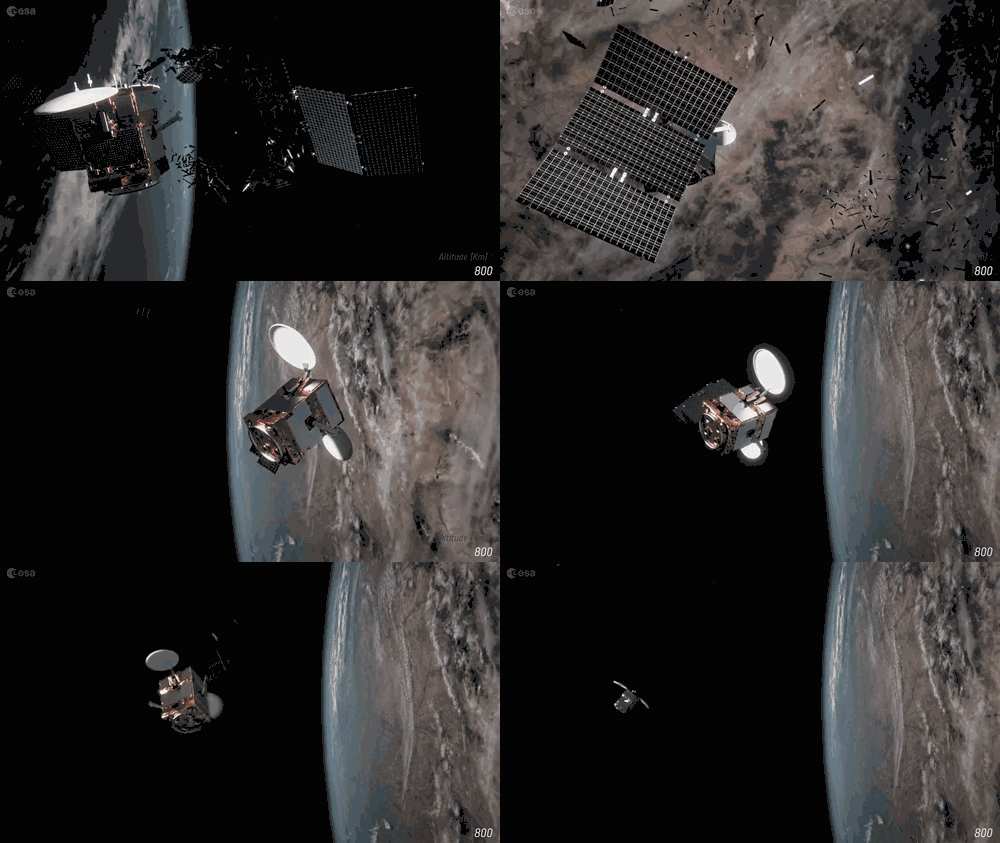
Around ten years later — and until today — we can see this effect go into full force. The emergence of satellite mega-constellations and an insane launch cadence are the proof. Constellations such as Starlink are now launching tens of satellites into orbit per week and private companies are now popping up left and right.
Today, there are thousands of operational satellites in orbit with hundreds of thousands of pieces of debris in space. In 2024, there were 145 launches in the U.S. alone and SpaceX accounted for 138 of them. This shows how a single company can drive the cadence of a nation through the roof.
With all the objects in space today, all future objects launched are at an increasingly higher risk of collision. Satellites frequently make anti-collision avoidance maneuvers, which deplete their fuel quicker and shorten their life span. This means that newer ones have to be made with such maneuvers in mind, which then makes them heavier and bulkier, taking up even more space.
You can read more on how much debris specifically is in space today, how much of which kind, and what the companies are doing to reverse this issue in my previous article here:
SNW #44: All you need to know about Space Debris
In conclusion, the increase in space launch cadence is undeniable. With more and more launches, the risks of in-space collisions are progressively higher. This means that humans are at more risk of launching into space or staying aboard space stations than ever before. This all sounds scary, and it isn’t as bad as it is — the chances of in-space collisions are still very minimal, but they are higher now than at any time in history.
If we as humans do not slow down or make a huge effort to clean up our orbit, we will see consequences, and they are not far away.
Comments
Post a Comment